
What Does GO INTO OVERDRIVE mean?

If you’ve ever heard someone say a team “went into overdrive” before a deadline, you’ve probably wondered about the exact meaning of “go into overdrive.” Is it positive? Is it stressful? Is it formal or informal?
In this blog post, you’ll learn the definition of “go into overdrive,” real-life examples, usage tips, register notes, origin, and common synonyms. Whether you’re a teacher of English or an advanced learner looking to expand your vocabulary, this guide will help you understand and confidently use this powerful expression in natural English.
What Does “Go Into Overdrive” Mean?
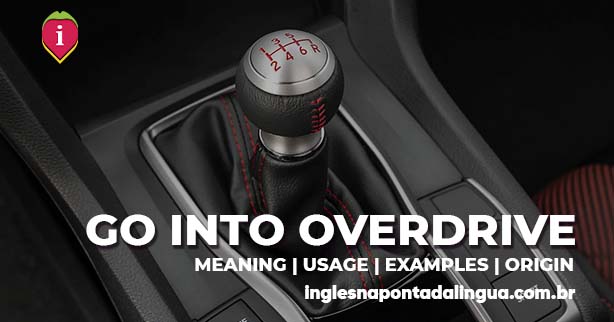
Go into overdrive means to start working or operating at a much higher level of intensity, speed, or effort than usual.
In simple terms, when someone or something goes into overdrive, they suddenly increase energy, activity, or productivity — often because of pressure, urgency, or excitement.
Think of it as:
Normal mode → Maximum effort mode.
It can refer to:
- A person (mental or physical effort)
- A company or team (productivity)
- Emotions (excitement, anxiety)
- Machines or systems (literal or metaphorical intensity)
Common Variations
- Go into overdrive
- Kick into overdrive
- Shift into overdrive
- Be in overdrive
- Work in overdrive
All of them revolve around the idea of heightened intensity.
Examples of “Go Into Overdrive”
Here are real-life style examples that show how native speakers use the expression:
- As soon as the deadline was announced, the whole team went into overdrive.
- My brain goes into overdrive the night before an exam.
- Sales usually kick into overdrive during the holiday season.
- When she gets excited about a project, she shifts into overdrive.
- His imagination went into overdrive after watching that sci-fi movie.
- The company went into overdrive to fix the public relations crisis.
- My anxiety goes into overdrive before public speaking.
- Once the kids arrived, the house went into overdrive.
- The marketing department kicked into overdrive after the product launch.
- During emergencies, hospital staff instantly go into overdrive.
Notice how flexible the expression is. It can describe productivity, emotions, creativity, stress, or even chaos.
When Should You Use “Go Into Overdrive”?
1. Register (Formality)
“Go into overdrive” is informal to semi-formal.
It works well in:
- Everyday conversation
- Business contexts
- Journalism
- Blogs and articles
It is less common in very formal academic writing, but it may still appear in metaphorical use.
2. Literal vs. Figurative Meaning
Originally, overdrive refers to a mechanical gear that allows an engine to run at high speed with lower engine rotation. Today, the expression is mostly figurative.
Example (literal – rare in daily speech):
- The car shifted into overdrive on the highway.
Example (figurative – very common):
- Her brain went into overdrive.
3. Emotional Connotation
The expression can be:
- Positive (productivity, motivation)
- Negative (stress, anxiety, overload)
- Neutral (simply high activity)
Context determines the tone.
Origin of “Go Into Overdrive”
The word overdrive comes from mechanical engineering and the automotive world.
In cars, overdrive is a gear mechanism that allows the vehicle to operate at higher efficiency at high speeds. When a car “shifts into overdrive,” it adjusts to operate more intensely and efficiently at speed.
Over time, English speakers borrowed this mechanical concept and applied it metaphorically to people, emotions, businesses, and systems. This kind of metaphorical extension is very common in English (think of expressions like “burn out,” “rev up,” or “run out of steam”).
So when someone says their brain “went into overdrive,” they’re using a mechanical metaphor to describe intense mental activity.
Conclusion: Mastering “Go Into Overdrive”
Now you know the full meaning of go into overdrive, how it’s used in real contexts, its origin, variations, and common synonyms.
To summarize:
- It means to operate at a much higher level of intensity or effort.
- It’s usually figurative.
- It works in both personal and professional contexts.
- It has strong expressive power in modern English.
Add it to your active vocabulary — and the next time pressure builds or excitement spikes, you’ll know exactly how to describe it.

