
What does WIPE THE SLATE CLEAN mean?

What does wipe the slate clean actually mean? Where does it come from? And how do native speakers use it in everyday English?
Get ready!
In this guide, you’ll learn the meaning of “wipe the slate clean,” its origin, real examples, usage tips, and similar expressions. By the end, you’ll be able to recognize and use this idiom confidently in natural English.
What Does “Wipe the Slate Clean” Mean?
According to the Longman Dictionary, the expression “wipe the slate clean” means:
to agree to forget about mistakes or arguments that happened in the past
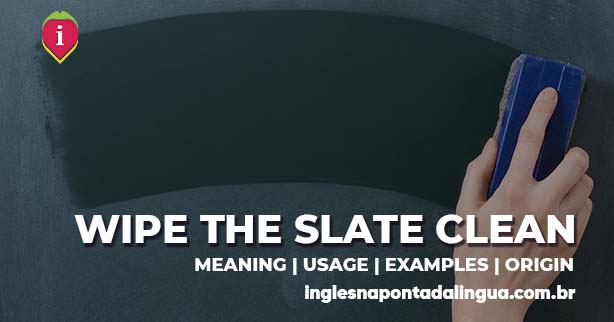
In other words, it can also be defined as to start again without being affected by past mistakes, problems, or negative situations.
When someone wipes the slate clean, they choose to forget past issues and begin again with a fresh start.
It often implies:
- forgiving someone
- resetting a situation
- removing past records or mistakes
- giving someone another chance
In simple terms, to wipe the slate clean is to begin again as if the past problems never happened.
Simple explanation
If something goes wrong and people decide to wipe the slate clean, they agree to leave the past behind and start over.
Examples of “Wipe the Slate Clean”
Here are realistic and natural examples showing how the expression wipe the slate clean is used in everyday English.
- The company decided to wipe the slate clean and rebuild its reputation after the scandal.
- After years of arguing, they agreed to wipe the slate clean and try to fix their friendship.
- The new manager wiped the slate clean and gave everyone a fresh opportunity.
- Sometimes the best solution is to wipe the slate clean and start again.
- He apologized and asked if they could wipe the slate clean.
- The government promised to wipe the slate clean and reform the system.
- Let’s wipe the slate clean and move forward.
- When the new year begins, many people feel it’s time to wipe the slate clean.
- She decided to wipe the slate clean after the difficult divorce.
- The teacher wiped the slate clean and allowed the class to redo the assignment.
These examples show that the expression is common in personal, professional, and institutional contexts.
When Can You Use “Wipe the Slate Clean”?
The idiom wipe the slate clean is considered neutral and widely acceptable in both informal and semi-formal contexts.
Common contexts where it appears
Personal relationships
- forgiveness
- second chances
- rebuilding trust
Example:
They decided to wipe the slate clean and move on.
Business and management
- organizational changes
- restructuring
- leadership transitions
Example:
The CEO wiped the slate clean and introduced a new strategy.
Politics and institutions
- reforms
- policy resets
- amnesties
Example:
The new administration promised to wipe the slate clean.
Grammar patterns
The expression commonly appears in structures such as:
- wipe the slate clean
- decide to wipe the slate clean
- want to wipe the slate clean
- wipe the slate clean and start over
The Origin of “Wipe the Slate Clean”
The expression wipe the slate clean comes from old classroom practices.
Before notebooks and paper became common, students wrote on small slate boards using chalk. These boards were reusable.
When the teacher wanted students to start a new exercise, they would simply wipe the slate clean, removing everything written on it.
Over time, the literal action became a metaphor for starting over without previous marks or mistakes.
So when someone says “let’s wipe the slate clean,” they are essentially saying:
Let’s erase the past and begin again.
Synonyms and Similar Expressions
English has several expressions that convey a similar idea to wipe the slate clean.
Common alternatives
Start from scratch
begin again with nothing already prepared
Example:
We had to start from scratch.
Start fresh
begin again with a new perspective
Example:
Let’s start fresh tomorrow.
Turn over a new leaf
change behavior and begin improving
Example:
He promised to turn over a new leaf.
Reset the situation
common in business or technical contexts
Example:
We need to reset the process.
Make a fresh start
Example:
Moving to another city helped her make a fresh start.
These alternatives help learners expand vocabulary while understanding the same core concept.
In a nutshell…
The idiom wipe the slate clean is a powerful and widely used expression in English. It describes the idea of leaving past mistakes behind and starting again with a fresh beginning.
Because it appears in daily conversations, professional settings, and media, understanding this expression helps learners sound more natural and interpret English more accurately.
So the next time you hear someone say “let’s wipe the slate clean,” you’ll know exactly what they mean — a fresh start without the weight of the past.


