
What does SWING FOR THE FENCES mean?

What’s the meaning of SWING FOR THE FENCES? How and when to use this expression naturally in English?
If you’ve ever heard this phrase and wondered what it really means, you’re in the right place.
In this article, you’ll learn how to use swing for the fences in real-life communication, what it implies in different contexts, and how it compares to a common variation: go for the fences. By the end, you’ll feel confident using both expressions naturally.
SWING FOR THE FENCES | meaning
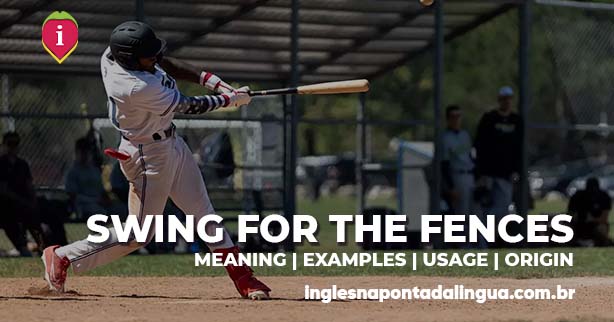
The expression swing for the fences means to make a big effort to achieve something great, often by taking a risk. It suggests aiming for a major success rather than playing it safe.
Think of it like this: instead of doing something small or cautious, you go all in — you try to achieve something impressive, even if there’s a chance of failure.
The variation go for the fences has the same meaning. The difference is mostly stylistic. Swing sounds a bit more vivid because it directly refers to the action behind the expression (we’ll get to that later).
Examples of SWIN FOR THE FENCES
- She decided to swing for the fences and apply for a job at a top international company.
- If we’re going to invest in this project, we might as well swing for the fences.
- He swung for the fences with his presentation, adding bold ideas and creative visuals.
- They went for the fences when they launched their startup globally from day one.
- I know it’s risky, but sometimes you have to swing for the fences to grow.
- The director really swung for the fences with that ambitious film.
- Instead of playing it safe, she went for the fences and proposed a completely new strategy.
- He’s not afraid to swing for the fences, even if it means failing sometimes.
- We only have one chance, so let’s swing for the fences.
- They went for the fences in the final round and ended up winning big.
When and How to Use SWING FOR THE FENCES
This expressions is used when talking about big goals and taking risks. It means trying to achieve something great instead of playing it safe. For example, “Let’s swing for the fences with this project” means “let’s aim high.”
It’s informal to semi-formal and common in conversations, work, and motivational contexts. When you use it, you show ambition and boldness. Most of the time, it’s positive, but it can also suggest someone is being too ambitious.
In simple terms, it means making a strong effort to get the best possible result, even if there’s a risk of failure.
The Origin of SWING FOR THE FENCES
The expression comes from baseball.
In baseball, when a player swings for the fences, they try to hit the ball as far as possible — ideally out of the stadium(a home run). It’s a powerful, aggressive move, but also risky: if you swing too hard, you might miss completely.
That’s exactly the idea behind the expression in everyday English:
👉 You aim big.
👉 You take the risk.
👉 You accept that failure is part of the game.
In a Nutshell…
Swing for the fences means to aim for big success by taking bold risks instead of playing it safe. It’s widely used in both personal and professional contexts to describe ambitious actions. The variation go for the fences carries the same meaning, just with a slightly different tone.
If you want to sound more natural and expressive in English, this is exactly the kind of chunk you should start using.
Want to Teach and Learn English Like This?
If you’re a teacher of English and want to confidently teach expressions like swing for the fences — not as isolated vocabulary, but as real, usable language — then you need to rethink how you approach teaching.
That’s exactly what you’ll find in the LEXICAL TEACHER program.
Inside the course, you’ll learn how to:
- teach English through chunks of language
- move beyond grammar-heavy lessons
- help students speak more naturally and fluently
- design lessons that reflect how English is actually used
More than that, you’ll upgrade your professional positioning as a teacher who truly understands how language works in real communication.
👉 If you’re ready to swing for the fences in your teaching career, this is your next step.


