What Does “BE POLLYANNA ABOUT” Mean?”

If you’ve ever heard someone say “Don’t be so Pollyanna about it”, you may have wondered what BE POLLYANNA ABOUT really means. This expression is common in modern English and is especially useful for understanding opinions, attitudes, and tone in conversations, articles, podcasts, and movies.
In this post, you’ll learn the meaning, real-life examples, origin, and synonyms of be Pollyanna about, using clear explanations and natural English suitable for English Learners ad teachers as well.
Meaning of “Be Pollyanna About”
BE POLLYANNA ABOUT (something) means:
To be unrealistically optimistic or positive about a situation, often ignoring problems, risks, or negative facts.
When someone is Pollyanna about something, they focus only on the good side and underestimate difficulties.
🔑 Core idea: too optimistic to be realistic
How “Be Pollyanna About” Is Used in Real English
This expression is usually used to criticize or question excessive optimism. It often appears with verbs like be, stop, don’t be, or sound.
Natural Examples
- She’s being Pollyanna about the economy. Things aren’t improving that fast.
- We can stay hopeful, but we can’t be Pollyanna about the challenges ahead.
- He sounds Pollyanna about the project, considering the lack of funding.
- I don’t want to be Pollyanna about it, but the situation is serious.
- The article is too Pollyanna about climate change and ignores real data.
These examples show how the expression is used to balance hope vs. realism.
Common Grammar Pattern
The most frequent structure is:
be + Pollyanna + about + noun / situation
Examples:
- be Pollyanna about the future
- be Pollyanna about success
- be Pollyanna about the risks
Origin of the Expression “Pollyanna”
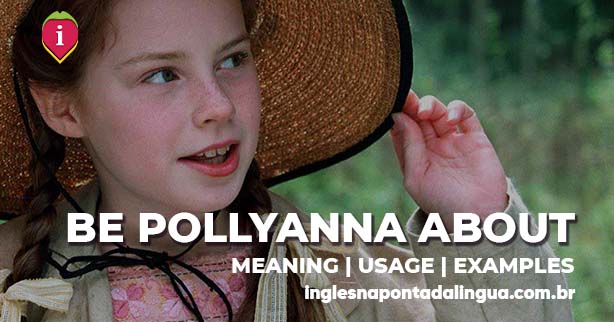
The expression comes from the novel Pollyanna (1913) by Eleanor H. Porter.
Pollyanna is a young girl who plays the “Glad Game”, always finding something positive in every situation— even in very difficult circumstances.
Over time, her name became a cultural reference. In modern English, Pollyanna often has a negative or ironic tone, meaning optimism that ignores reality.
📌 That’s why be Pollyanna about does not simply mean “be positive”—it means being positive to an unrealistic degree.
Synonyms and Related Expressions
Here are common synonyms and near-synonyms used in everyday English:
Neutral / Descriptive
- overly optimistic
- unrealistically positive
- naively hopeful
More Informal / Conversational
- rose-colored glasses
- She’s looking at the situation through rose-colored glasses.
- too idealistic
- wishful thinking
- That’s just wishful thinking.
Idiomatic Alternatives
- see everything as sunshine and rainbows
- ignore the red flags
- paint too rosy a picture
Pollyanna vs. Realistic Optimism
It’s important to note that English often contrasts Pollyanna thinking with realistic optimism.
- ✅ Realistic optimism: hope + awareness of problems
- ❌ Pollyanna attitude: hope without acknowledging reality
Example:
- It’s good to stay positive—but don’t be Pollyanna about the risks.
When to Use (and Avoid) “Be Pollyanna About”
✔️ Use it when talking about:
- business decisions
- politics
- health
- economics
- social issues
❌ Avoid it in very formal academic writing. It’s more common in:
- journalism
- opinion pieces
- spoken English
- blogs and podcasts
In a nutshell…
- Be Pollyanna about = be too optimistic and unrealistic
- Often used to criticize excessive positivity
- Comes from the novel Pollyanna by Eleanor H. Porter
- Common in modern spoken and written English
- Frequently paired with real-world topics and opinions
If you want to sound more natural and confident in English, learning expressions like be Pollyanna about helps you understand not just what people say — but how they think.