
What Does CUT TO THE QUICK mean?

What’s the meaning of CUT TO THE QUICK? How to use the idiom CUT SOMEONE TO THE QUICK correctly in English? When and where can CUT TO THE QUICK be used?
That’s exactly what you’re going to learn by reading this article.
So, let’s star!
What Does “Cut to the Quick” Mean?
The idiom “cut to the quick” means:
to hurt someone’s feelings a lot
That’s the definition we read from the Cambridge Online Dictionary.
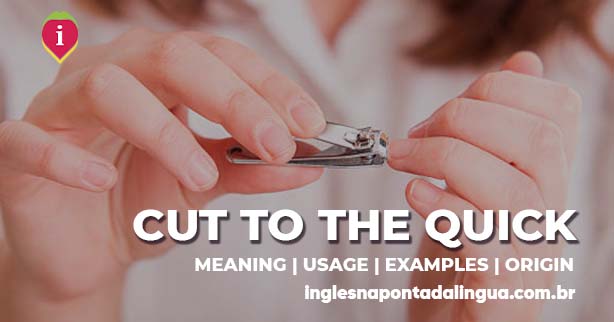
So, in short when you cut someone to the quick, it means you hurt that perso deeply — emotionally, not phisically.
To make it even easier to understand: when something cuts you to the quick, it touches a very sensitive emotional spot. It feels personal. It stings. It goes straight to the heart.
For example:
- A harsh comment.
- A betrayal.
- A criticism that feels unfair.
- A truth you weren’t ready to hear.
It’s not just “a little hurt.” It’s deeply hurt.
The key idea behind the meaning of cut to the quick is emotional vulnerability.
Examples of “Cut to the Quick”
Here are natural examples of how native speakers use cut to the quick:
- Her comment about my accent really cut me to the quick.
- I laughed it off, but honestly, it cut me to the quick.
- When he questioned my integrity, it cut me to the quick.
- That joke about my family cut me to the quick.
- His silence hurt more than words — it cut me to the quick.
- Being left out of the project cut her to the quick.
- The criticism wasn’t loud, but it cut him to the quick.
- Hearing that from my best friend cut me to the quick.
- The review cut the author to the quick.
- She tried to stay calm, but the remark had cut her to the quick.
Notice something important:
The structure is usually:
- Something cut someone to the quick
- It cut me/him/her to the quick
It’s commonly used in the past tense because it refers to an emotional reaction to something that happened.
When Should You Use “Cut to the Quick”?
Understanding the register of an idiom is crucial.
“Cut to the quick” is:
- Slightly formal
- Literary in tone
- Common in writing
- Less common in casual conversation
You’re more likely to see it in:
- Literature
- Opinion pieces
- Speeches
- Thoughtful reflections
- Emotional storytelling
In everyday conversation, people might choose simpler alternatives like:
- “That really hurt.”
- “That hit hard.”
- “That stung.”
Still, the idiom cut to the quick adds intensity and sophistication — which makes it excellent for advanced learners and teachers of English.
The Origin of “Cut to the Quick”
The origin of cut to the quick is fascinating.
The word “quick” originally meant “alive” in Old English. We still see this meaning in expressions like:
- “The quick and the dead”
In this idiom, “the quick” refers to the sensitive living tissue under your fingernails or toenails. If you’ve ever trimmed your nails too short and accidentally cut into that sensitive area — you know exactly how painful it is.
So metaphorically:
- Cutting “to the quick” = cutting into living, sensitive tissue
- Emotionally = hurting someone deeply where they are most vulnerable
It’s a vivid image — and that’s why the idiom has survived for centuries.
Synonyms and Related Expressions
Here are some synonyms and related expressions similar to cut to the quick:
- Hit a nerve
- Strike a nerve
- Cut deep
- Sting
- Wound someone
- Hurt someone’s feelings
- Touch a sore spot
- Rub salt in the wound
- That hit hard (informal)
- That was brutal (informal)
For teaching purposes, you can contrast:
- “Hit a nerve” → triggers sensitivity
- “Cut to the quick” → causes deep emotional pain
Subtle difference — powerful teaching opportunity.
In a nutshell…
To sum up, cut to the quick is an English idiom meaning to hurt someone deeply on an emotional level. Its origin is physical, but its use is emotional and metaphorical. It carries intensity, vulnerability, and depth.
If you want your English to sound more natural, expressive, and precise, adding idioms like cut to the quick to your active vocabulary is a smart move.
Language isn’t just grammar — it’s emotion.
And this idiom proves it.


