
What does BE AT ONE’S WITS’ END mean?

What’s the meaning of BE AT ONE’S WITS’ END? How and when to use this expression naturally in English?
If you’ve ever felt completely stuck, frustrated, and unsure about what to do next, this is exactly the kind of situation where native speakers might use this expression. In this guide, you’ll learn not only what it means, but also how to use it naturally in real-life communication.
The meaning of BE AT ONE’S WITS’ END
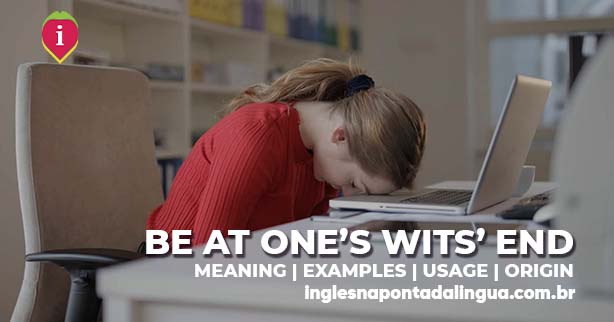
The expression be at one’s wits’ end means to feel extremely frustrated or overwhelmed because you don’t know what to do about a problem anymore.
In simple terms, it describes a situation where:
- You’ve tried everything you can think of
- Nothing seems to work
- You feel mentally exhausted and out of ideas
The word wits refers to your ability to think, reason, and solve problems. So, if you are “at your wits’ end,” it means your thinking resources are basically used up.
Examples of BE AT ONE’S WITS’ END
Here are some natural examples showing how the expression is used in different tenses and situations:
- I’m at my wits’ end with this project. Nothing is working.
- She was at her wits’ end trying to get her kids to sleep.
- They’ve been arguing for weeks, and he’s at his wits’ end.
- I’ll be at my wits’ end if this keeps happening.
- We were at our wits’ end before we finally found a solution.
- He’s at his wits’ end dealing with customer complaints all day.
- I was at my wits’ end, so I asked for help.
- She’ll be at her wits’ end if the situation doesn’t improve.
- They are at their wits’ end trying to fix the issue.
- I’m honestly at my wits’ end with this constant noise.
When and How to Use This Expression
This expression is commonly used in situations involving:
1. Ongoing frustration
When something has been happening for a while and nothing seems to solve it.
Example: dealing with a difficult student, a broken system, or repeated mistakes.
2. Emotional exhaustion
It’s not just a problem — it’s the feeling that comes with it. You’re tired, stressed, and mentally drained.
3. Informal and semi-formal contexts
It works well in conversations, emails, and even storytelling. It’s natural but slightly expressive, so it adds emotional weight.
4. Common patterns
You’ll often hear it with:
- I’m at my wits’ end with…
- She’s at her wits’ end trying to…
- They were at their wits’ end because…
The Origin of the Expression
The expression dates back to Old and Middle English. The word wit originally meant “intelligence” or “mental sharpness.”
Back then, people used wits to refer to their mental faculties — basically their ability to think and reason.
So, being “at your wits’ end” meant reaching the limit of your mental capacity — a point where you could no longer think of any solutions.
Over time, the phrase became fixed as an idiom and is still widely used in modern English.
In a Nutshell…
Be at one’s wits’ end means feeling completely overwhelmed and out of ideas when facing a problem.
It’s a powerful, natural expression used to describe frustration, mental exhaustion, and the moment when you’ve tried everything — but nothing seems to work.
Mastering expressions like this helps you sound more natural and expressive in English, especially when talking about real-life situations and emotions.
» This post was first published in Portuguese on February 12, 2024.
