What Does BACK TO SQUARE ONE Mean in English?

Have you ever heard someone say “back to square one” and wondered what it really means?
If so, you’re in the right place.
In this article, you’ll learn:
- Its meaning
- How to use it correctly in real situations
- Common examples
- Its possible origins
- And why this idiom is so popular in English
Let’s get started.
Back to Square One: Meaning in English
This idiom means:
To return to the beginning of a process after a failure and start again from zero.
In other words, when a plan doesn’t work, and you need to restart everything, you are back to square one.
Most English dictionaries define it as:
If you are back to square one, you have to start dealing with something from the beginning again because the way you were dealing with it has failed.
You may also find the variation “back at square one.”
However, “back to square one” is by far the most common and preferred form in modern English.
When Do We Use “Back to Square One”?
We usually use this expression when:
- A project fails
- A plan doesn’t work
- A solution creates more problems
- Progress is lost
- We need to restart from the beginning
It is very common in professional, academic, and personal contexts.
Examples of “Back to Square One” in Sentences
Here are some natural examples:
- If this doesn’t work, we’re back to square one.
- We’ll have to go back to square one if the government pulls our funding.
- Another relationship ended. I’m back to square one again.
- The treatment failed, and she was back to square one.
- After losing all the data, the team had to go back to square one.
These examples show how the idiom is used in everyday English.
Where Did It Come From?
The exact origin of this expression is uncertain. However, linguists usually mention three main theories.
1️⃣ Sports Commentary Theory (UK)
Some people believe the expression came from early football or rugby radio commentaries in the UK.
According to this theory, the field was divided into “squares,” and returning to the first area meant restarting play.
However, most linguists consider this explanation weak.
2️⃣ Board Games Theory (Snakes and Ladders)
Another theory connects the expression to board games, especially Snakes and Ladders.
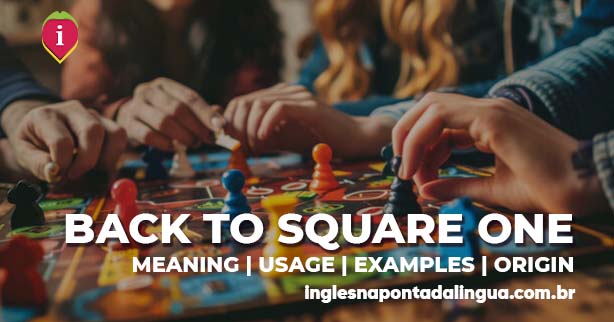
In these games, when a player lands on a bad square, they may have to return to the beginning — square number one.
Although interesting, historical evidence suggests this theory is also uncertain.
3️⃣ Hopscotch (Children’s Game) Theory
A third explanation comes from the game hopscotch.
When players make a mistake, they must return to the first square and start again — literally “back to square one.”
This theory is considered one of the most plausible.
Historical Note
The expression first appeared in written records around 1952, which makes it difficult to link it conclusively to any single activity.
In practice, the exact origin is less important than understanding how to use the idiom correctly.
🔹 Why “Back to Square One” Is So Useful in English
This idiom is popular because it is:
✔️ Easy to understand
✔️ Emotionally expressive
✔️ Suitable for formal and informal contexts
✔️ Widely used in business, education, and daily conversation
Mastering expressions like this helps learners sound more natural and fluent.
🔹 Final Thoughts
Now you know that this idiom means returning to the beginning after a failure and starting again.
Learning idioms like this is essential for improving your comprehension, vocabulary, and speaking skills in English.
Keep exploring, keep practicing, and keep learning.
📚 Sources
» This blog post was first published in Portuguese on March 06, 2019.