What does WEAR YOUR HEART ON YOUR SLEEVE mean?

If you are learning English idioms, improving your advanced English vocabulary, or teaching natural English expressions, you’ve probably come across the expression “wear your heart on your sleeve.”
In this complete guide, you’ll learn:
- The exact meaning of wear your heart on your sleeve
- Real and natural example sentences
- Its register and usage
- The possible origin of the expression
- Useful synonyms and related slang
- Teaching tips for ESL/EFL contexts
This article is designed for English learners, ESL teachers, and advanced students who want to sound more natural and understand how idiomatic language works in real communication.
What Does “Wear Your Heart on Your Sleeve” Mean?
The idiom wear your heart on your sleeve means:
To openly show your emotions and feelings instead of hiding them.
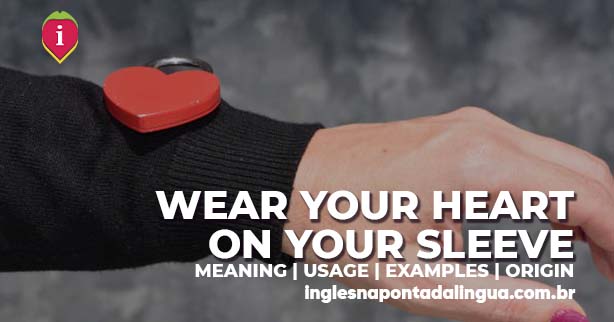
If you wear your heart on your sleeve, people can easily see how you feel. You don’t pretend. You don’t mask your emotions. You’re emotionally transparent.
Simple Explanation
- ❤️ “Heart” = emotions
- 👕 “Sleeve” = visible part of your clothing
- If your heart is “on your sleeve,” everyone can see it.
In other words, your feelings are not hidden — they are on display.
Is It Positive or Negative?
It depends on context.
- It can be positive (honest, authentic, emotionally open).
- It can be negative (too sensitive, emotionally exposed).
That duality makes wear your heart on your sleeve a powerful idiomatic expression in English.
Real and Natural Examples of “Wear Your Heart on Your Sleeve”
Here are authentic-style examples that reflect natural spoken and written English:
- She really wears her heart on her sleeve — you always know when she’s upset.
- I’ve always worn my heart on my sleeve, and sometimes that gets me into trouble.
- He’s not the type to wear his heart on his sleeve. He keeps his feelings private.
- As a leader, she wears her heart on her sleeve and connects emotionally with her team.
- In relationships, wearing your heart on your sleeve can be risky — but also rewarding.
- You could tell he was disappointed. He wears his heart on his sleeve.
Notice the Grammar Pattern
The structure is very stable:
- wear(s) + possessive adjective + heart + on + possessive adjective + sleeve
Examples:
- I wear my heart on my sleeve.
- She wears her heart on her sleeve.
- They wear their hearts on their sleeves.
In the plural form, we often say:
- They wear their hearts on their sleeves.
Register and Usage: When and How to Use It
Understanding the register of an idiom is essential for sounding natural in English.
Is “Wear Your Heart on Your Sleeve” Formal?
It is generally:
- Informal to semi-formal
- Common in spoken English
- Acceptable in journalistic and literary contexts
You’ll hear it in:
- Everyday conversations
- Interviews
- Self-development talks
- Movies and TV shows
- Articles about relationships or leadership
It is not typically used in highly formal academic writing, but it is perfectly natural in essays, blogs, and opinion pieces.
Pragmatic Note for English Learners
This idiom is often used:
- To describe personality
- To contrast emotional openness vs. emotional reserve
- To comment on vulnerability
Example contrast:
She wears her heart on her sleeve, but her brother is much more guarded.
For ESL teachers, this makes it a great expression to teach when discussing:
- Personality traits
- Emotional intelligence
- Relationships
- Leadership styles
Origin of “Wear Your Heart on Your Sleeve”
The expression wear your heart on your sleeve dates back to the 16th century.
It is famously used by William Shakespeare in Othello (1604).
In the play, the character Iago says:
“But I will wear my heart upon my sleeve
For daws to peck at.”
Here, the meaning suggests vulnerability — exposing one’s heart to be attacked.
There are also theories that in medieval times, people wore tokens of affection on their sleeves during tournaments to show loyalty or romantic attachment.
While historical evidence is debated, Shakespeare’s usage strongly popularized the idiom in English.
Synonyms and Related Expressions
If you understand wear your heart on your sleeve, you should also know these related expressions:
Close Synonyms
- Be emotionally open
- Be transparent about your feelings
- Be an open book
- Be emotionally expressive
- Show your true feelings
Example:
He’s an open book — he really wears his heart on his sleeve.
Opposites
- Keep your feelings to yourself
- Be emotionally reserved
- Be guarded
- Hide your emotions
- Keep a poker face
Example:
She never wears her heart on her sleeve. She keeps a poker face.
Related Slang (Modern Usage)
- Put yourself out there
- Be vulnerable
- No filter (informal, personality-related)
Note: “No filter” is not a direct synonym, but it overlaps in meaning when referring to emotional transparency.
Conclusion: Why “Wear Your Heart on Your Sleeve” Matters
The idiom wear your heart on your sleeve is a powerful and expressive English idiom used to describe emotional openness and vulnerability.
By learning:
- Its meaning
- Its grammar pattern
- Its register
- Its origin
- Its synonyms
You expand not just your vocabulary, but your ability to describe personality and emotional behavior in natural English.
For English learners and teachers, mastering expressions like wear your heart on your sleeve is essential for fluency, authenticity, and communicative confidence.
Keep learning idiomatic English — that’s where real fluency begins.